
Mobilization Economics: Why Governments Always Discover Unlimited Money During Emergencies
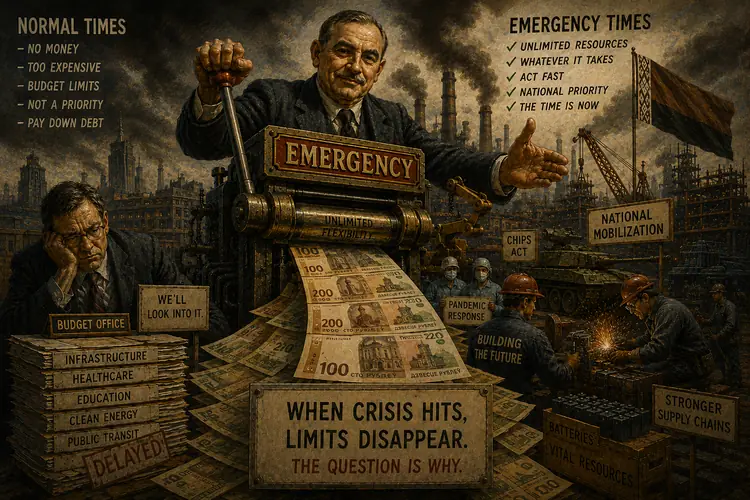
The Most Expensive Words in Economics
There are few phrases more financially powerful than:
“We are facing an emergency.”
Once those words appear, economic rules begin changing remarkably fast.
Budgets suddenly expand. Debt limits become flexible. Governments discover hidden urgency. Central banks cooperate. Industries reorganize. Gigantic spending packages appear almost overnight.
And perhaps the strangest part is this: the same governments that spent years explaining why certain projects were “unaffordable” suddenly find trillions of dollars when the crisis becomes serious enough.
This pattern repeats constantly throughout history. Wars. Financial collapses. Pandemics. Energy crises. Strategic competition. National security fears.
During ordinary times, economics sounds strict.
During emergencies, economics becomes psychological.
World War II: The Great Economic Transformation
The clearest example of mobilization economics was World War II.
Before the war, the United States was still struggling with the aftershocks of the Great Depression. Unemployment remained high. Industrial production was inconsistent. Economic confidence was fragile.
Then the war arrived.
And suddenly the impossible became possible. Factories expanded at astonishing speed. Automobile plants began producing tanks and aircraft. Shipyards exploded with activity. Millions of workers entered industrial production. Government spending reached levels previously considered unimaginable.
The United States transformed itself into a gigantic production machine.
And remarkably, it worked.
The war economy demonstrated something deeply important: modern governments could coordinate economic activity on enormous scale when sufficiently motivated.
That realization permanently changed how governments viewed their own power.
The Discovery of “Unlimited” Capacity
War mobilization revealed an uncomfortable truth about economics: many limitations are political until they become psychological emergencies.
For years, governments may argue endlessly over:
- infrastructure spending
- industrial policy
- healthcare funding
- energy systems
- technological investment
Then a national emergency appears.
Suddenly:
- debt expands rapidly
- production surges
- money flows freely
- regulations weaken
- political resistance fades
Entire industries can be rebuilt faster than anyone previously claimed possible.
This creates a dangerous public question: if governments can mobilize massive resources during crises, were the earlier “limitations” entirely real?
Politicians usually prefer not to discuss that question too deeply.
War Bonds and Emotional Economics
One of the most fascinating aspects of mobilization economies is emotional participation.
During World War II, Americans were encouraged to buy war bonds. This was not merely finance. It was psychology.
Citizens were told:
- sacrifice matters
- spending habits matter
- production matters
- saving matters
- patriotism matters
The economy itself became part of the national war effort. Mobilization economics transforms ordinary citizens into participants in a larger collective mission.
And people often accept extraordinary economic changes during periods of emotional unity. Price controls? Acceptable. Rationing? Necessary. Massive deficits? Patriotic. Government coordination? Temporary.
That final word is always important: temporary.
History suggests temporary emergency systems have a habit of becoming surprisingly durable.
The Return of Industrial Policy
For decades, many Western economies embraced globalization and relatively open markets.
Governments increasingly stepped back from direct industrial management.
Then reality intervened. Supply chains became fragile. Strategic industries moved overseas. Semiconductor shortages appeared. Geopolitical tensions intensified.
And suddenly governments rediscovered industrial policy. The United States began subsidizing semiconductor production. Strategic manufacturing became politically fashionable again. Energy independence returned as a major national concern. Supply chains became matters of national security.
In other words: mobilization thinking quietly returned even outside wartime.
Not tanks and ration books this time. Microchips. Batteries. Rare earth minerals. Artificial intelligence. Energy grids.
Modern mobilization economies increasingly revolve around technological competition.
COVID Felt Like Wartime Economics
The pandemic created one of the largest peacetime mobilizations in modern history.
And the similarities to wartime economics were striking.
Governments:
- coordinated production
- intervened directly in markets
- expanded deficits massively
- subsidized industries
- controlled movement
- prioritized strategic supply chains
Central banks injected enormous liquidity. Emergency programs expanded everywhere. Entire sectors survived primarily through state support.
The scale was extraordinary. And for a while, much of the public accepted it because the emergency felt genuine.
That is one of the defining features of mobilization economics: people tolerate levels of government intervention during fear that would feel shocking during normal times.
Fear changes economic philosophy very quickly.
Emergencies Expand Government Power Fast
There is an old political reality that appears repeatedly throughout history:
nothing expands state power faster than crisis.
Emergencies justify:
- faster spending
- centralized authority
- industrial coordination
- surveillance
- economic intervention
- temporary restrictions
Sometimes those actions are genuinely necessary.
But temporary emergency measures have a strange tendency to survive after the emergency itself fades away. Institutions grow. Programs remain. Agencies expand. Deficits continue.
And because crises appear regularly, governments increasingly operate in a semi-permanent state of “managed urgency.”
In modern politics, there is almost always:
- a security threat
- an economic threat
- a technological threat
- an environmental threat
- a geopolitical threat
The result is a system where extraordinary intervention slowly starts feeling ordinary.
The New Era of Economic Nationalism
Today, major economies increasingly resemble strategic competitors rather than purely free-market systems.
The United States competes with China not only economically, but industrially and technologically.
Governments now openly discuss:
- strategic industries
- domestic manufacturing
- critical minerals
- AI leadership
- energy security
This is not classical free-market language. It is mobilization language.
Economic systems are increasingly treated as instruments of geopolitical power.
And once governments begin viewing industries through a national-security lens, intervention becomes much easier to justify.
A semiconductor factory no longer looks like merely a business investment. It becomes: “critical infrastructure.”
That single phrase changes everything politically.
Green Energy and the New Mobilization Logic
Climate policy has also introduced a new form of mobilization economics.
Governments now spend enormous sums attempting to accelerate:
- renewable energy
- electric vehicles
- battery production
- energy infrastructure
- carbon reduction technologies
Supporters argue this is necessary to avoid long-term catastrophe. Critics argue governments are distorting markets heavily. But both sides increasingly speak the language of emergency. And emergency language changes public tolerance for spending.
When leaders frame something as existential, almost any budget becomes easier to justify.
That is one of the most powerful financial mechanisms in modern politics.
The Line Between Market and State Is Blurring
One of the biggest economic shifts of the 21st century is philosophical.
For decades, Western economies promoted the image of relatively free markets operating independently.
Today, the reality looks more complicated.
Governments heavily influence:
- interest rates
- industrial priorities
- strategic investment
- energy systems
- technology development
- supply chains
- labor markets
Private companies still exist. Competition still exists. But increasingly, markets operate alongside large-scale government coordination. The line separating capitalism from state management is becoming less clear.
Not because markets disappeared. But because crises repeatedly justify deeper intervention.
Why Crises Always Find Money
This brings us to the uncomfortable core question.
Why do governments always seem to discover enormous amounts of money during emergencies?
Partly because emergencies change political incentives. Voters tolerate debt during fear. Opposition weakens. Central banks cooperate. Speed becomes more important than caution.
But there is another reason. Modern governments controlling sovereign currencies possess extraordinary financial flexibility compared to ordinary households or businesses. That flexibility remains politically constrained during normal periods.Emergencies temporarily remove those constraints.
Which means “there is no money” often translates into: “there is currently no political urgency.”
That realization permanently changes how citizens view government budgets.
The Future May Be Permanently Mobilized
Perhaps the strangest possibility is that modern economies are drifting toward continuous mobilization. Not necessarily military mobilization. But permanent strategic management.
Governments increasingly prepare for:
- pandemics
- cyberwarfare
- climate threats
- AI disruption
- supply-chain shocks
- geopolitical competition
And every new threat justifies another layer of coordination, spending, and intervention.
The result may be a future where emergency economics quietly becomes normal economics. A world where markets continue operating — but always under the shadow of large-scale state management.
And if that happens, future generations may look back at the old idea of completely “free markets” the same way we now look at gold-backed currencies: interesting, historically important, and perhaps slightly mythical.