
LNG: The Technology That Turned Gas Into a Global Commodity
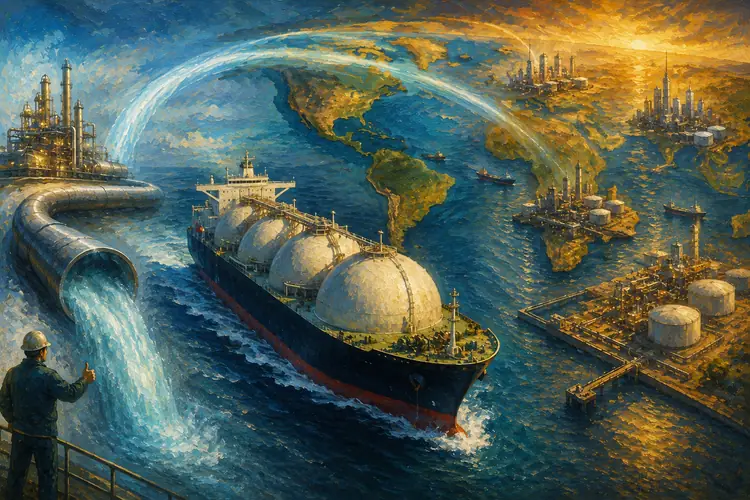
Imagine trying to transport a giant cloud across an ocean. That sounds impossible.
For most of human history, moving natural gas over long distances was almost as impractical. Pipelines could carry gas across continents, but oceans were natural barriers.
Countries separated by water often had no realistic way to trade natural gas, no matter how much one needed it or the other had to sell.
Then engineers discovered a remarkable solution. Instead of changing geography, they changed the gas. By cooling natural gas to approximately −162°C (-260°F), it becomes a liquid occupying only about one six-hundredth of its original volume.
Suddenly, something that once filled an enormous pipeline could fit inside a specially designed tanker. The invention did not simply improve transportation. It transformed the economics of the global energy market.
Natural gas stopped being a mostly regional commodity. It became a global one.
Turning a Cloud Into a Liquid
Liquefied Natural Gas, better known as LNG, sounds complicated.
The basic idea is surprisingly simple. Natural gas leaves the ground as a gas. Before it can be liquefied, impurities such as water, carbon dioxide and sulfur compounds must be removed. The clean methane is then cooled step by step until it reaches extremely low temperatures.
At that point, something extraordinary happens. The gas becomes a clear, colorless liquid.
No chemistry changes. It is still natural gas. Only its physical state changes. Its volume shrinks by roughly 600 times, making long-distance transportation economically possible. Once it reaches its destination, the liquid is warmed back into gas before entering pipelines that deliver it to homes, factories and power plants.
The entire journey looks remarkably elegant: Gas field → Processing plant → Liquefaction terminal → LNG tanker → Import terminal → Regasification → Pipeline → Consumer.
It sounds straightforward. Building this chain is anything but.
The Most Expensive Supply Chain in Energy
Oil wells are expensive. Pipelines are expensive. But LNG combines nearly every expensive piece of infrastructure imaginable.
First comes the liquefaction plant. These facilities are among the most complex industrial projects ever constructed. Some cost more than twenty or even thirty billion dollars before exporting a single cargo.
Then come the ships. LNG carriers are not ordinary tankers. Their insulated storage tanks must keep cargo close to −162°C while crossing entire oceans. Even a small amount of heat entering the tanks causes part of the liquid to evaporate, requiring sophisticated engineering to manage safely.
Finally, importing countries need another major investment. Receiving terminals must unload the liquid, store it, warm it back into gas and connect it to domestic pipeline systems.
In other words, LNG is not simply a fuel. It is an entire transportation system.
That explains why pipeline gas is usually cheaper whenever a direct pipeline already exists.
LNG is purchased not because it is inexpensive. It is purchased because it offers something even more valuable: Choice.
The Countries That Built an Industry
Few industries have changed as rapidly as LNG.
For decades, Qatar dominated global exports by investing heavily in enormous liquefaction facilities fed by one of the world's largest natural gas fields.
Australia later became another export giant, serving rapidly growing Asian markets.
Malaysia and Indonesia established themselves as reliable suppliers across Southeast Asia.
Nigeria demonstrated how LNG could allow gas-rich African nations to reach customers thousands of miles away.
Then came the United States. The shale revolution dramatically increased American natural gas production. Instead of worrying about shortages, the United States suddenly faced abundant supplies. Export terminals appeared along the Gulf Coast. Within little more than a decade, the United States became one of the world's largest LNG exporters. It was one of the fastest transformations ever seen in global energy.
Canada is now following a similar path. New LNG facilities on Canada's Pacific coast will allow Canadian gas to reach Asian markets more directly, reducing travel times compared with shipments leaving the Gulf of Mexico.
The Buyers Live Far From the Gas
Most major LNG buyers have something in common. They lack sufficient domestic energy resources.
Japan is the classic example. As an island nation with limited natural gas reserves, it has depended on imported LNG for decades.
South Korea faces similar geographical challenges.
China continues increasing LNG imports as its economy grows and energy demand expands.
India's rapidly developing industrial sector also requires increasing volumes of imported gas.
Europe has become another major destination. For many years, pipelines supplied much of Europe's natural gas. As supply patterns changed during the early 2020s, LNG imports expanded dramatically. New receiving terminals appeared faster than many experts believed possible.
Entire coastlines became gateways for global gas trade.
When Gas Learned to Chase the Highest Price
Pipelines are predictable. Ships are flexible. That single difference changed the economics of natural gas.
Imagine an LNG tanker leaving Qatar. Its original destination might be Japan. Halfway through the voyage, prices suddenly surge in Europe because of an unexpected cold winter. Instead of continuing east, the cargo may change course and sail toward Europe if contracts permit.
Oil has always behaved this way. LNG gradually introduced similar flexibility to natural gas. Cargoes now move toward markets willing to pay the highest price.
As more LNG entered international trade, regional gas markets became increasingly connected. Prices no longer moved independently as often as they once did. Events occurring thousands of miles away could suddenly influence gas prices at home.
A cold winter in Asia. A hurricane in the Gulf of Mexico. Maintenance at an Australian export terminal.
Each could affect prices across several continents. The gas market had become global.
America's Unexpected Energy Story
Few people predicted the scale of America's transformation. Only a generation ago, many experts believed the United States would become one of the world's largest LNG importers. Instead, horizontal drilling and hydraulic fracturing unlocked vast shale gas resources.
Domestic production surged. Prices remained relatively low compared with many overseas markets. Exporting suddenly became profitable. American LNG cargoes now sail regularly to Europe, Asia and Latin America.
This has created new economic opportunities far beyond the energy sector. Ports expanded. Ship traffic increased. Engineering firms received new contracts. Manufacturing industries benefited from reliable domestic gas supplies.
An innovation beneath American soil reshaped markets across the globe.
Competition Is Good for Buyers
LNG has not eliminated pipelines. Nor will it. Pipelines remain the cheapest option whenever neighboring countries can connect directly.
Instead, LNG has created competition. A country buying pipeline gas now has another option. An LNG cargo arriving by sea.
Likewise, LNG exporters must compete not only with each other but also with pipeline suppliers. Competition generally improves bargaining power for buyers.
It also increases resilience. If one supplier faces disruption, another may be able to fill part of the gap.
No energy system becomes completely immune to shocks. But diversification usually makes markets stronger.
The Next Chapter
Global LNG demand is expected to continue growing, particularly across Asia.
The United States and Qatar are both expanding export capacity through massive new projects.
Canada is preparing to enter Asian markets in a much larger way.
New floating LNG terminals are reducing construction times for importing countries. Technology continues lowering costs while improving efficiency.
At the same time, questions remain. Will renewable energy slow future gas demand? Will hydrogen eventually compete with natural gas in heavy industry? Will carbon capture make natural gas more environmentally acceptable?
No one knows the exact answers. But one thing seems clear. Natural gas is no longer limited by geography in the way it once was.
Pipelines connected neighbors. LNG connected continents.
The molecule itself never changed. Human ingenuity changed the way it travels. And by changing transportation, it changed the global market.