
IoT + AI: When the Physical World Becomes Intelligent
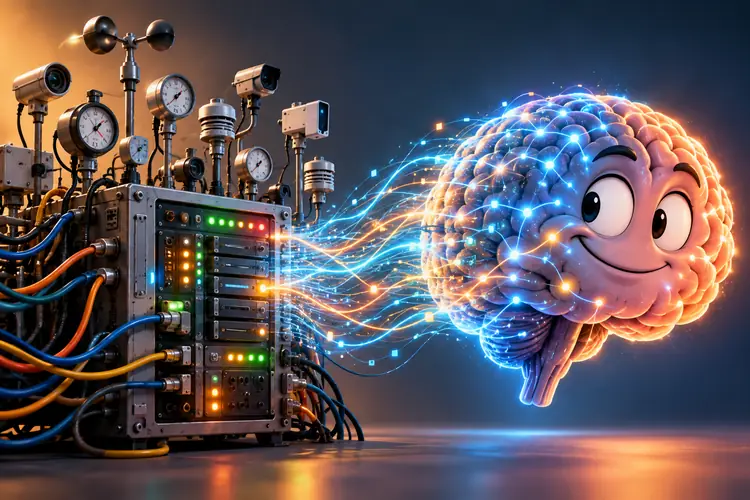
For years, we have been putting sensors into things.
Cars measure speed, temperature, pressure, location, and dozens of other variables. Factories monitor motors and pumps. Farms measure soil moisture. Buildings watch energy consumption. Cameras observe streets, warehouses, and stores.
We created an enormous nervous system for the physical world. There was only one problem.
Having senses doesn't make you intelligent.
A temperature sensor can tell you that a machine is getting hot. It cannot necessarily tell you why, whether it matters, or what should happen next.
That is where AI enters the story. IoT gave machines the ability to sense the world. AI is beginning to give them the ability to understand it.
The Problem With a Billion Sensors
Imagine a factory with 10,000 sensors. Every second, they produce information about vibration, pressure, temperature, sound, electricity, movement, and production.
Wonderful. Now imagine being the person who has to look at it.
The great promise of IoT created an unexpected problem: too much information. A sensor can generate data continuously, but most of that data is boring. Motor temperature: normal. Pressure: normal. Vibration: normal. Motor temperature: still normal. Repeat this a few million times.
The economically valuable moment is the unusual one. Something has changed. And finding that moment inside oceans of ordinary data is exactly the kind of problem AI can help solve.
From Measurement to Meaning
There is a fundamental difference between measurement and understanding.
Suppose a pump begins vibrating 8% more than usual. Is that dangerous? Perhaps. But maybe the factory increased production. Maybe the temperature outside changed. Maybe another machine nearby is causing the vibration. Or perhaps this is exactly how the last three pumps behaved two weeks before their bearings failed.
A sensor alone doesn't know. AI can compare patterns across time, machines, operating conditions, and historical failures. That creates a powerful combination:
IoT tells us what is happening.
AI helps us decide what it means.
This is why the marriage of IoT and AI matters economically. The valuable product isn't more data. It is better decisions made from data.
A Farm That Watches Every Plant
Agriculture makes the idea wonderfully tangible. Traditional farming often involves treating large areas similarly. Irrigate the field. Apply fertilizer. Inspect the crop.
But fields aren't actually uniform. One section may be dry while another has enough water. One group of plants may show early signs of disease. Another may be perfectly healthy.
Sensors, cameras, drones, and connected machinery can collect information about these differences. Then AI can interpret it. Computer vision can identify patterns in crops. Soil sensors can provide moisture data. Weather information can be combined with conditions in the field.
Instead of asking: "Does this field need water?" the system can increasingly ask: "Which part of this field needs water, how much, and when?"
That distinction matters. Water, fertilizer, pesticides, fuel, and labor all cost money.
Intelligence means using resources where they create the most value.
The Traffic Light That Starts Thinking
Now move from a farm to a city intersection.
Traditional traffic lights are surprisingly simple. Green. Yellow. Red. Repeat. Some respond to basic sensors or programmed schedules.
But combine cameras, connected vehicles, road sensors, and AI, and the intersection can become more adaptive. How many cars are waiting? Is a bus approaching? Has an accident blocked one lane? Are pedestrians crossing? Is traffic building several intersections away?
The traffic light stops being merely a timer. It becomes part of a system trying to optimize flow.
And here the economic consequences become easy to miss. Saving one driver two minutes means almost nothing. Saving hundreds of thousands of drivers two minutes, repeatedly, begins to mean something. Less fuel. Less wasted time. Fewer emissions. More productive hours.
Tiny efficiencies become economically interesting when multiplied by entire cities.
When the Machine Can Act
But AI plus IoT becomes much more consequential when the system doesn't merely recommend an action. It performs one.
A building detects that rooms are empty and reduces heating. A warehouse notices demand changing and adjusts cooling. An irrigation system detects dry soil and releases water. A factory identifies abnormal equipment behavior and slows a machine. An electrical system shifts consumption away from an expensive period.
Now something important has happened. The loop has closed:
Sense → Understand → Decide → Act
At that point, we are approaching something that looks less like a traditional machine and more like an autonomous economic agent. It observes conditions. It evaluates alternatives. It consumes resources. It responds to prices or constraints. It acts.
Your smart thermostat was a tiny preview of this world.
Intelligence Moves to the Edge
There is another change happening quietly. Not every decision can wait for data to travel to a distant cloud server. A self-driving vehicle cannot encounter an obstacle and politely wait for the Internet. An industrial safety system may need to react immediately.
So some AI is moving closer to where the data is produced — into cameras, vehicles, machines, gateways, and other devices. This is often called edge AI.
The idea matters because it can reduce delays, limit how much data must be transmitted, and allow some systems to operate even when connectivity is poor.
The physical world doesn't always have time to upload itself before making a decision.
Sometimes intelligence needs to be standing next to the machine.
But What Happens When AI Is Wrong?
There is an uncomfortable difference between AI on a screen and AI in the physical world. If an AI system recommends the wrong movie, you waste two hours. If it incorrectly interprets a factory sensor, controls an energy system badly, or makes the wrong decision in a vehicle, the consequences can be physical and expensive.
That makes reliability, cybersecurity, human oversight, and accountability much more important.
Who is responsible when an autonomous system makes the wrong decision? The device manufacturer? The AI developer? The company operating it? The human who trusted it?
Connecting intelligence to the physical world doesn't eliminate human responsibility. It makes responsibility harder to locate.
The Physical World Gets a Brain
The Internet digitized information. Smartphones digitized much of our social and commercial lives. IoT is digitizing the physical world.
AI adds something new. It allows that digital representation to be interpreted continuously and, increasingly, acted upon.
Factories can notice. Buildings can adapt. Farms can respond. Vehicles can react. Power systems can optimize.
None of these things are intelligent in the human sense. But economically, that distinction may matter less than we think. A machine doesn't need consciousness to save electricity. A warehouse doesn't need emotions to reduce waste. A factory doesn't need imagination to notice a failing bearing. It simply needs enough information to make a better decision than it made yesterday.
For years, we connected the physical world so that machines could tell us what was happening. Now we are teaching them what to do about it.
IoT gave the physical world senses. AI is giving it something that begins to look like a brain.