
Interest Rates: The Most Powerful Dial in the Economy
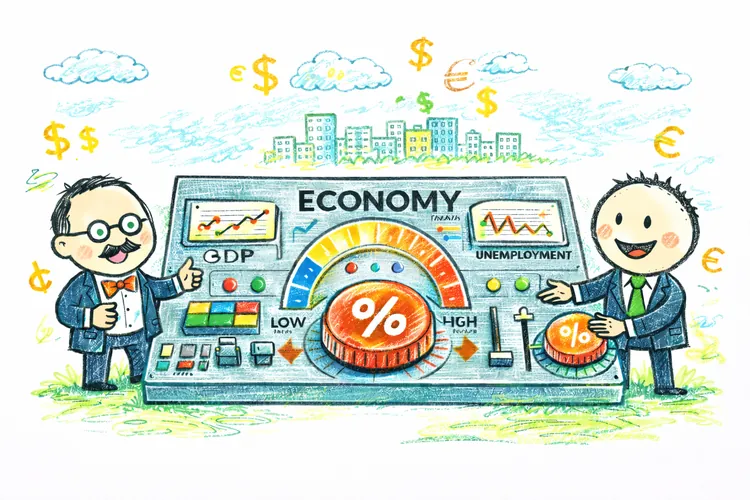
Imagine the economy as a giant machine.
Millions of businesses producing goods.
Hundreds of millions of people working, spending, and investing.
Trillions of dollars moving every day.
Now imagine that somewhere on the wall of this machine there is a single dial.
Turn it one way, and the economy speeds up.
Turn it the other way, and things begin to slow down.
That dial is called interest rates.
And adjusting it is one of the most powerful tools in modern economics.
What Is an Interest Rate?
At its simplest, an interest rate is the price of borrowing money.
If you borrow $1,000 from a bank at a 5% interest rate, you will repay the loan with about $50 in interest each year.
Interest rates influence almost every financial decision in the economy:
- mortgages
- car loans
- credit cards
- business investments
- government borrowing
Even stock markets respond quickly to changes in interest rates.
Who Controls Interest Rates?
In modern economies, interest rates are heavily influenced by central banks.
In the United States, this role belongs to the Federal Reserve.
In Canada, it is the Bank of Canada.
These institutions set what is known as the policy interest rate — the benchmark that influences borrowing costs throughout the economy.
When central banks adjust this rate, commercial banks typically adjust their lending rates soon afterward.
Why Central Banks Change Interest Rates
Central banks adjust interest rates mainly to keep the economy stable.
Their most important target is inflation.
If inflation rises too quickly, central banks usually raise interest rates.
Higher borrowing costs slow spending and investment, helping reduce inflation.
If the economy weakens or unemployment rises, central banks may lower interest rates to encourage borrowing and economic activity.
You can think of interest rates as a thermostat for the economy.
Too hot? Turn the dial down.
Too cold? Turn it up.
What Happens When Rates Rise
When interest rates increase, borrowing becomes more expensive.
This affects the economy in several ways:
- mortgages become more costly
- car loans become more expensive
- businesses delay investment
- consumers reduce spending
As demand slows, inflation often begins to fall.
But this also slows economic growth.
For this reason, raising interest rates is sometimes described as putting the brakes on the economy.
What Happens When Rates Fall
Lower interest rates have the opposite effect.
Borrowing becomes cheaper.
As a result:
- mortgages become more affordable
- businesses invest more
- consumers spend more
This can stimulate economic growth, especially during recessions.
Cutting interest rates is therefore often compared to pressing the accelerator on the economy.
Why Markets React So Quickly
Few economic announcements move financial markets faster than interest rate decisions.
Investors closely watch central bank meetings.
Even small adjustments — such as 0.25 percentage points — can influence:
- stock markets
- bond markets
- exchange rates
- housing prices
That is because interest rates affect the cost of money across the entire economy.
When the price of money changes, almost everything else adjusts.
The Balancing Act
Managing interest rates is a delicate task.
Raise them too much, and economic growth may slow sharply.
Lower them too much, and inflation may surge.
Interest rates are not just a tool — they are a balancing act between today’s growth and tomorrow’s stability. Turn them too fast, and the system reacts. Turn them too slowly, and the risks quietly build up.
Central banks therefore rely heavily on economic data such as:
- GDP growth
- inflation
- unemployment
These indicators help guide decisions about when to speed up or slow down the economic machine.