
Inflation: Why Prices Rise — and Why Everyone Notices
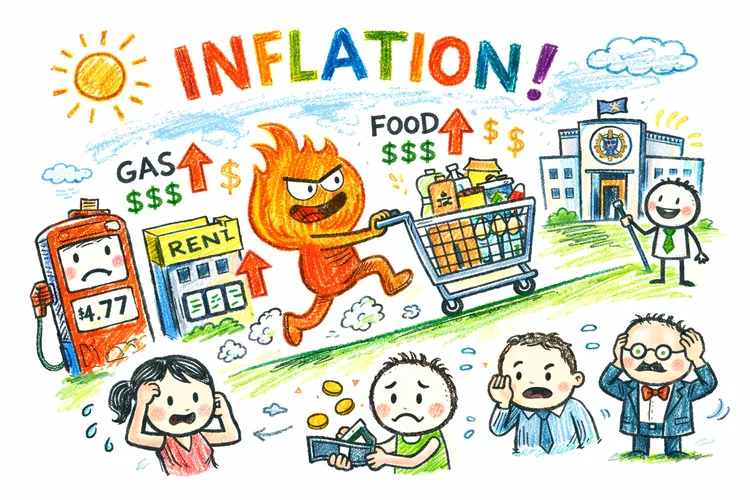
If GDP is the number economists talk about, inflation is the number everyone feels.
You don’t need an official report to notice inflation.
You see it in the grocery store.
You see it at the gas station.
You see it when your rent increases.
One year a cup of coffee costs $2.
A few years later it costs $3.50.
That gradual rise in prices over time is called inflation.
And although the term sounds technical, inflation quietly influences almost every financial decision people make.
When Prices Start to Feel Different
Most people remember the moment inflation becomes noticeable.
Maybe it’s when your weekly grocery bill suddenly feels higher.
Or when you return to a restaurant and the menu prices have all changed.
But inflation usually doesn’t happen overnight.
It’s more like a tide slowly rising.
A little each month.
By the end of the year, prices might be 2%, 3%, or 5% higher than before.
That may not sound dramatic — until you realize those increases compound year after year.
How Economists Measure Inflation
Economists track inflation using an indicator called the Consumer Price Index (CPI).
You can imagine CPI as a large shopping basket filled with common goods and services.
This basket includes items such as:
- food
- gasoline
- housing
- clothing
- medical care
- transportation
- electronics
Statistical agencies monitor the prices of thousands of items each month.
If the total cost of the basket increases, inflation has risen.
In the United States this data is produced by the Bureau of Labor Statistics.
In Canada it is calculated by Statistics Canada.
Why a Little Inflation Is Actually Helpful
At first glance, rising prices seem like a problem.
But economists usually prefer a small amount of inflation.
Most central banks aim for about 2% inflation per year.
Why?
Because moderate inflation often signals a healthy economy.
When businesses expect prices to rise slowly over time, they are more likely to:
- invest in new equipment
- hire workers
- increase wages
Consumers also tend to spend money rather than delay purchases indefinitely.
In other words, mild inflation helps keep economic activity moving.
When Inflation Becomes Dangerous
Problems arise when inflation accelerates too quickly.
If prices rise 8%, 10%, or even 20% per year, purchasing power erodes rapidly.
Savings lose value.
Household budgets become unpredictable.
Businesses struggle to plan.
History offers dramatic examples.
In 1920s Germany, hyperinflation became so extreme that people carried money in wheelbarrows.
More recently, countries like Argentina and Venezuela have experienced inflation rates high enough that prices can change within weeks.
Fortunately, such extremes are rare in modern advanced economies.
But even moderate inflation spikes can cause major political and economic concern.
The Role of Central Banks
When inflation rises too quickly, central banks intervene.
In the United States, this responsibility belongs to the Federal Reserve.
In Canada, it falls to the Bank of Canada.
Their main tool is interest rates.
When inflation rises, central banks typically increase interest rates.
Higher borrowing costs slow spending and investment.
Over time, weaker demand helps bring inflation back down.
This process is sometimes described as turning a giant dial on the economy.
Why Inflation Feels So Personal
One reason inflation is politically sensitive is that people experience it differently.
Higher airline ticket prices might barely affect someone who rarely travels.
But rising costs of food, gasoline, or housing affect nearly everyone.
That’s why inflation often dominates economic debates.
Even if GDP grows and unemployment remains low, rising prices can make people feel the economy is struggling.
The Balancing Act
Economists often describe inflation as a balancing act.
Too little inflation may signal weak demand and economic stagnation.
Too much inflation can destabilize the economy and erode trust in money itself.
The goal of policymakers is to keep inflation steady, predictable, and — ideally — boring.
In economics, boring is usually a good sign.