
If There Are Fewer Workers — Can Machines Take Over?
We’ve seen the problem.
Populations are aging.
Birth rates are falling.
Workforces are shrinking.
So naturally, a new idea appears:
What if we don’t need more people?
What if technology can fill the gap?
The Promise of Productivity
Economies don’t grow only because of more workers.
They also grow because workers become more productive.
One person with better tools can produce more than ten people a century ago.
That’s already happened:
- tractors replaced farm labor
- machines replaced factory lines
- software replaced manual processes
Now, the next wave is here.
Enter AI and Automation
Artificial intelligence, robotics, and automation are moving fast.
- warehouses run with minimal human staff
- algorithms handle customer service
- AI writes, analyzes, and designs
In theory, fewer workers might not matter as much.
If each worker produces more…
The economy can still grow.
Japan Tried First
Remember Japan from earlier?
With one of the oldest populations in the world, Japan leaned heavily into automation.
- robots in manufacturing
- self-checkout systems everywhere
- even robotic assistants in elder care
It works — to a point.
Japan remains productive and technologically advanced.
But it still struggles with:
- slow economic growth
- labor shortages
- rising costs of aging
Technology helped.
But it didn’t fully replace people.
The Limits of Machines
Here’s the key insight:
Not all work is the same.
Some jobs are easy to automate:
- repetitive tasks
- predictable processes
Others are much harder:
- healthcare
- education
- human interaction
You can build a robot to assemble a car.
It’s much harder to build one that replaces a nurse.
The Consumption Problem
There’s another angle that’s often overlooked.
Workers don’t just produce.
They also consume.
They:
- buy homes
- spend money
- drive demand
If the population shrinks, even a highly productive economy can face a new issue:
Who is buying the output?
An economy needs both supply and demand.
Machines can help with supply.
But they don’t go shopping.
A Different Kind of Balance
So the future may not be:
People vs. machines.
It may be:
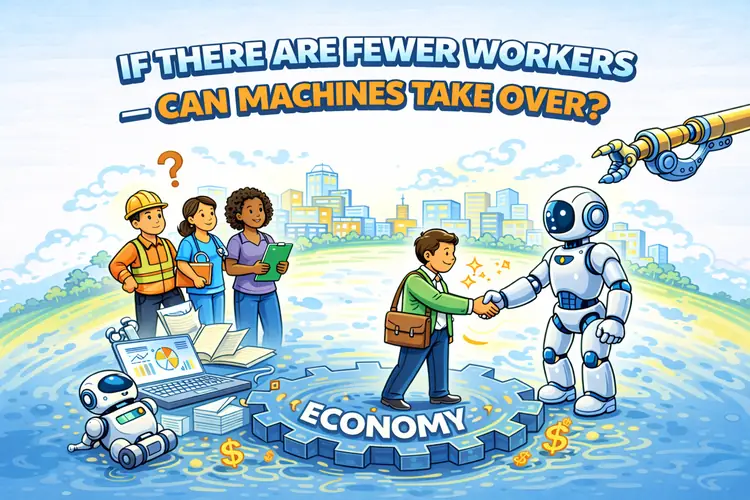
People + machines
- fewer workers
- but more productive ones
- supported by technology
The challenge is finding the right balance.
The New Competition
There’s also a global dimension.
Countries that successfully combine:
- strong demographics
- advanced technology
will likely grow faster.
Those that have neither may struggle.
So the race isn’t just about AI.
It’s about how AI interacts with people.
The Big Question
Technology is powerful.
But demographics are persistent.
You can upgrade software overnight.
You can’t grow a workforce overnight.
A Thought to Leave With
If fewer people are available to work…
And machines are getting better every year…
Then the future economy may depend on one question:
*Not whether technology replaces people —
but how well it works with them.*