
Grand Slam Economics: How Tennis Turned Tradition Into a Prize-Money Arms Race
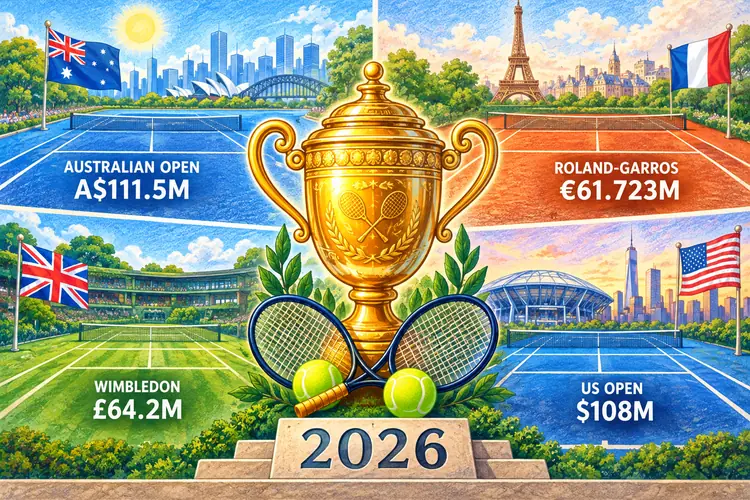
The four Grand Slam tournaments are tennis’s crown jewels. But they are also four remarkably successful businesses built around something economics loves: scarcity.
There are only four of them. You cannot create another Wimbledon, move Roland-Garros to another month, or manufacture another US Open. Each tournament owns a particular place in the calendar, a surface, a history — and increasingly, a very expensive piece of global attention.
And in 2026, the price of that attention reached another level.
Four Tournaments, Four Different Products
The Grand Slams do not really compete the way four rival sports leagues would. Instead, they form a sequence.
The Australian Open opens the season in Melbourne on hard courts, combining summer heat, late-night tennis and the feeling that every player is starting again.
Then comes Roland-Garros, where clay changes the economics of winning points as much as the tactics. Matches become longer and more physical, while Paris turns the tournament into a cultural event as well as a sporting one.
Wimbledon follows on grass, selling something almost impossible to reproduce: tradition. White clothing, Centre Court, strawberries and cream, and a surface barely used during the rest of the season.
Finally comes the US Open in New York — louder, bigger and more theatrical. Night sessions are part tennis match, part Broadway show. This variety is part of the business model.
Tennis does not sell the same championship four times. It sells four different versions of greatness.
2026: The Prize-Money Race Gets Serious
The 2026 season made one trend particularly clear: Grand Slam prize money continues to rise rapidly.
The Australian Open offered a record A$111.5 million, 16% more than in 2025. Singles champions Carlos Alcaraz and Elena Rybakina received A$4.15 million each.
At Roland-Garros, total prize money increased to €61.723 million, up 9.53%. Alexander Zverev won the men’s singles title, while 19-year-old Mirra Andreeva became the youngest women’s champion in Paris since Monica Seles in 1992. Each singles champion earned €2.8 million.
Then Wimbledon raised the stakes again. Its 2026 prize pool reached £64.2 million, an increase of 20% from 2025, with £3.6 million going to each singles champion. Jannik Sinner successfully defended his men’s title, while Linda Noskova won the women’s championship.
And then New York arrived. The 2026 US Open announced $108 million in total player compensation — 20% above the previous record of $90 million set just one year earlier. The men’s and women’s singles champions will receive $5.5 million each, the largest Grand Slam singles winner’s checks in history. Even a player losing in the first round receives $140,000.
The currencies make direct comparison difficult. But the direction does not.
Grand Slam tennis is becoming much more valuable.
The US Open: From Country Club to Global Spectacle
No tournament illustrates this transformation better than the US Open.
Its history begins in 1881, when the U.S. National Championships were first played on grass in Newport, Rhode Island. The tournament eventually established a long association with the West Side Tennis Club at Forest Hills in New York. For decades, this was recognizably old-world tennis: grass courts, clubs and traditions.
Then the sport changed. In 1968, professionals were admitted and the tournament entered the Open era.
Arthur Ashe won the men’s singles title that year, becoming the first US Open men’s champion of the Open era and the first African-American man to win a major singles championship.
The tournament then did something extraordinary. It changed surfaces — twice. Until 1974, the US Open was played on grass. From 1975 through 1977, Forest Hills used Har-Tru, commonly described as green clay. Then, in 1978, the tournament moved to Flushing Meadows and switched to hard courts. That makes the US Open unique among the four majors: it is the only Grand Slam tournament to have been played on three different surfaces.
That history says something important about the economics of the tournament.
Tradition mattered. But growth mattered more.
The Courts Became Part of the Business
The move to Flushing Meadows in 1978 was more than a change of address. It was a change in scale.
The original Louis Armstrong Stadium had an unusual previous life. It was created from the Singer Bowl, a venue associated with the 1964 New York World’s Fair that had also hosted concerts and boxing. Converted for the US Open, it became the tournament’s main stadium in 1978.
But tennis kept growing. By the 1990s, even Armstrong was no longer large enough for what the US Open had become. Attendance had risen from fewer than 100,000 spectators at the first US Open in 1968 to more than half a million by 1996.
So in 1997 came Arthur Ashe Stadium. With a capacity of nearly 24,000 spectators, it is the largest tennis stadium in the world. A retractable roof was added in 2016, turning rain from a major scheduling risk into a manageable inconvenience.
A completely new Louis Armstrong Stadium followed in 2018, with more than 14,000 seats and its own retractable roof. These are not simply places to put spectators. They are economic infrastructure. More seats mean more ticket revenue. Roofs protect television schedules. Night sessions create premium broadcast inventory. Hospitality suites attract corporate spending.
Bigger stages turn individual matches into global events. The stadium itself becomes part of the product.
The Champions Who Built the Brand
Of course, stadiums mean little without the people who play inside them. The history of the US Open reads like a compressed history of modern tennis.
Bill Tilden won seven men’s singles championships between 1920 and 1929. Arthur Ashe won the first Open-era tournament in 1968. Jimmy Connors won five US Open singles titles. John McEnroe won four. Ivan Lendl reached eight consecutive finals from 1982 through 1989. Pete Sampras won five titles. The women’s history is just as extraordinary. Chris Evert won six singles titles in the Open era. Martina Navratilova won four. Steffi Graf won five, including the 1988 US Open that completed her calendar-year Grand Slam. Serena Williams later won six singles titles of her own. And the tournament has repeatedly introduced new generations. A 17-year-old Venus Williams reached the final in 1997, the first year of Arthur Ashe Stadium. Serena Williams won her first US Open in 1999. Roger Federer then won an extraordinary five consecutive US Open titles from 2004 through 2008. Rafael Nadal, Novak Djokovic and, more recently, Carlos Alcaraz and Jannik Sinner added their own chapters to the tournament’s history.
That continuity is commercially priceless.
Fans are not buying tickets simply to watch forehands and serves. They are buying the possibility of seeing the next chapter of a story that began generations ago.
From $15 Million to $108 Million
This is where the economics becomes especially striking.
In 2000, the US Open distributed about $15 million in prize money, with the men’s and women’s singles champions receiving $800,000 each. By 2025, total player compensation had reached $90 million, with singles champions receiving $5 million each. One year later, the US Open raised the number again. In 2026, total player compensation reached $108 million, while each singles champion will receive $5.5 million. That means the headline compensation figure has grown more than sevenfold since 2000 in nominal terms.
Inflation explains part of that increase — but nowhere near all of it.
Something much larger happened. Tennis became much better at monetizing global audiences.
And the Money Is Moving Down the Draw
Perhaps the most interesting economic change is not what happens to the champion. It is what happens to the player who loses.
Grand Slam tennis is expensive. Players pay coaches, trainers, travel costs and other expenses long before knowing how far they will advance in a tournament.
For stars, those costs are manageable. For lower-ranked professionals, they can determine whether a career is financially sustainable.
The 2026 tournaments increasingly acknowledged that reality. At the Australian Open, the overall prize pool rose 16%, with significant increases in qualifying and player support. Roland-Garros increased its qualifying prize pool substantially. Wimbledon raised payments across its singles draw. And at the US Open, a player who simply reaches the singles main draw and loses in the first round receives $140,000. First-round qualifying payments start at $32,000. The US Open also introduced a new $2 million Player Support Program, equally divided between men and women, as part of a broader effort to improve economic security for professional players.
So the prize-money race is no longer only about producing a spectacular winner’s check.
It is increasingly about financing the ecosystem that produces the winners.
Why Can the Grand Slams Keep Paying More?
The answer comes down to three valuable things.
Scarcity. There are only four Grand Slams. Their status cannot easily be replicated.
Narrative. Every match is connected to decades of champions, rivalries, records and national identities.
Global attention. Tennis offers sponsors and broadcasters an international audience concentrated around four globally recognizable events. And there is a fourth factor becoming increasingly important:
players themselves are demanding a larger share of the value they help create.
That creates an unusual competition. The Grand Slams compete for prestige, but they also compete over who can demonstrate that their tournament is the biggest stage, the best experience and increasingly the best place to be a professional tennis player.
The Grand Slam Is No Longer Just a Trophy
The 2026 season shows how far the business has moved.
A Grand Slam used to be defined mainly by history: Wimbledon grass, Paris clay, Melbourne sunshine, New York nights. Those things still matter.
But today a Grand Slam is also a media platform, a hospitality business, a global advertising property, a huge physical venue and an increasingly sophisticated mechanism for distributing hundreds of millions of dollars through professional tennis.
The US Open may be the clearest example. It began on a quiet grass court in Newport in 1881. It moved through Forest Hills, changed surfaces twice, migrated to Flushing Meadows, built the largest stadium in tennis and eventually created a tournament offering $108 million in player compensation.
That is more than the history of a tennis tournament. It is the story of how a sporting tradition became a global business — without ceasing to be a tradition. And perhaps that is the real economic genius of the Grand Slams.
They discovered that history itself can be an appreciating asset.
Advertisement
728 x 90