
Government Debt: How Much Is Too Much?
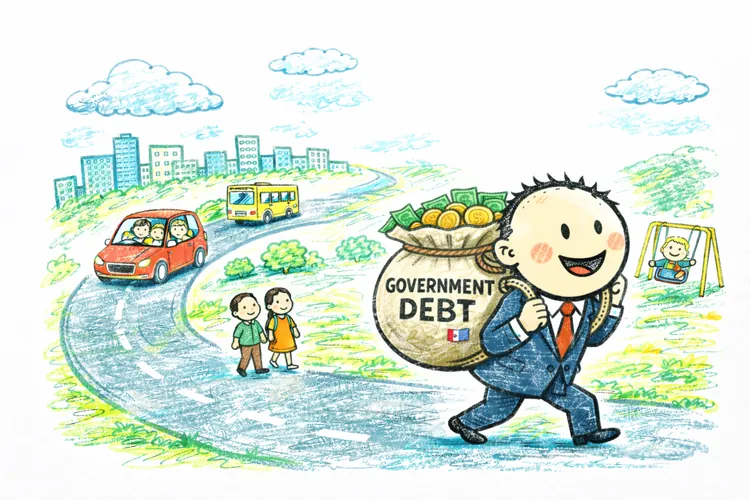
Imagine a household taking out a loan.
Perhaps it is a mortgage to buy a home.
Maybe a loan to start a small business.
Or a credit card balance that will be paid later.
Borrowing itself is not necessarily a problem.
In fact, many important things in life — homes, education, businesses — are built with borrowed money.
Countries work in a similar way.
Governments borrow money too.
And when they do, it becomes what economists call government debt.
Why Governments Borrow
Governments spend money on services that benefit society as a whole.
For example:
- highways and bridges
- schools and universities
- healthcare systems
- defense and security
- scientific research
Sometimes tax revenues are enough to cover these costs.
But often governments spend more than they collect.
When that happens, they borrow the difference by issuing government bonds — essentially IOUs sold to investors.
Investors purchase these bonds because governments usually promise repayment with interest.
The Key Number Economists Watch
Government debt alone doesn’t say much.
A large economy can usually carry more debt than a small one.
That’s why economists look at a specific ratio:
debt relative to GDP.
This compares how much a country owes with how much its economy produces each year.
Examples:
- The United States has government debt exceeding 100% of GDP.
- Canada’s federal debt ratio is significantly lower.
- Japan’s debt exceeds 200% of GDP.
At first glance, these numbers may seem alarming.
But the reality is more complex.
Why Some Countries Can Borrow More
Not all debt carries the same risk.
Countries with strong institutions, stable economies, and reliable tax systems can usually borrow more safely.
Investors trust that these governments will repay their debts.
That’s why countries like the United States, Canada, Germany, and Japan can borrow large amounts at relatively low interest rates.
Their government bonds are often considered among the safest investments in the world.
In times of financial uncertainty, investors often rush to buy them.
When Debt Becomes Dangerous
Debt becomes problematic when investors begin to doubt a government’s ability to repay it.
If confidence falls, interest rates on government borrowing can rise rapidly.
Higher borrowing costs make debt even harder to manage.
This situation contributed to crises in several countries.
During the European debt crisis of the 2010s, countries like Greece faced soaring borrowing costs and severe economic pressure.
In extreme cases, governments may default on their debt, meaning they fail to repay lenders fully.
Fortunately, such events are relatively rare among advanced economies.
Debt Can Also Stabilize the Economy
Government borrowing is not always harmful.
During economic crises, it can be essential.
When the economy weakens, governments often increase spending to support households and businesses.
This occurred during the 2008 financial crisis and again during the COVID-19 pandemic.
Emergency spending programs helped stabilize economies, but they also increased government debt.
Many economists believe these actions prevented deeper recessions.
The Long-Term Question
The real challenge of government debt lies in long-term sustainability.
Borrowing today means future budgets must include interest payments.
If debt grows faster than the economy for too long, governments may face difficult choices:
- raising taxes
- cutting spending
- borrowing even more
This is why economists carefully monitor debt trends over time.
Government borrowing can support economic growth — but only if it remains manageable.