
Gold as a Metal, Not a Myth
Gold dazzles before it convinces.
It catches the eye in a shop window, survives centuries in the ground, and quietly keeps modern technology alive where failure is not an option.
Long before gold was measured in ounces or tracked on charts, it was valued for something much simpler:
it does things other materials can’t.
A Metal That Behaves Differently
From a materials-science point of view, gold is an oddity.
It is:
- one of the best electrical conductors available
- extraordinarily malleable — a single gram can be beaten into a sheet large enough to cover a small table
- chemically inert — it does not rust, tarnish, or react with air or water
- biocompatible — the human body accepts it without protest
Most metals excel at one or two of these traits.
Gold combines all of them.
That combination is rare. And expensive. And incredibly useful.
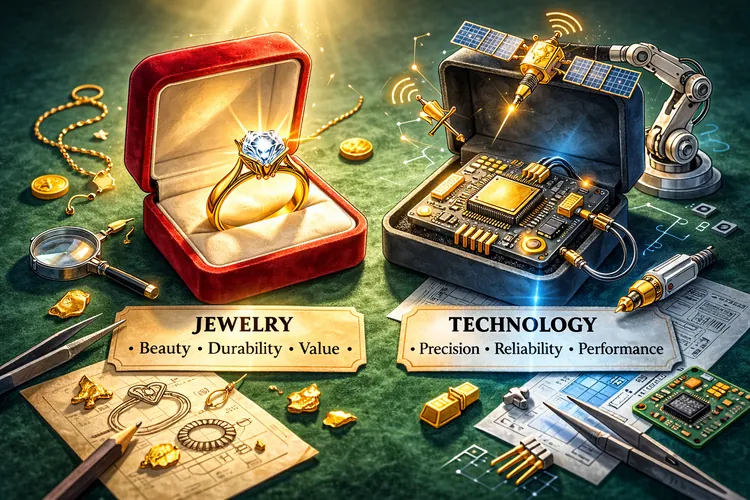
Jewelry: Where Beauty Meets Physics
Roughly 45–50% of all newly mined gold each year ends up as jewelry.
That’s not just culture or tradition.
It’s metallurgy.
Gold is ideal for jewelry because it:
- keeps its shine indefinitely
- can be shaped into impossibly thin wires and intricate forms
- doesn’t irritate skin
- and doesn’t degrade over generations
A gold ring is not fashionable for a season.
It’s engineered to outlast its owner.
That durability is why gold jewelry functions as adornment, heirloom, and portable wealth at the same time.
Technology: Gold Where Failure Is Not Allowed
Only about 7–10% of annual gold demand comes from industrial and technological uses — a small share by volume, but a critical one by function.
Gold is used in:
- microchips and circuit boards
- high-reliability connectors
- satellites and spacecraft
- medical devices and implants
- precision instruments and sensors
Why gold?
Because it doesn’t corrode.
Because it doesn’t lose signal quality.
Because it works the same way after years of heat, cold, vibration, and radiation.
In environments where repair is impossible — space, sealed electronics, inside the human body — gold is chosen not because it’s precious, but because it’s reliable.
Medicine, Dentistry, and the Human Body
Gold’s relationship with the human body is unusually calm.
It doesn’t oxidize.
It doesn’t poison tissue.
It doesn’t provoke immune reactions.
That’s why gold has long been used in:
- dentistry
- implants
- targeted medical treatments
- diagnostic equipment
In medicine, gold is not decorative.
It’s trusted.
Why Gold Is Hard to Replace
Engineers constantly try to substitute cheaper materials.
Sometimes they succeed.
Often, they don’t.
Gold is used where:
- maintenance is impossible
- longevity matters more than cost
- precision matters more than volume
It is expensive — but failure is usually more expensive.
That’s why gold keeps returning to designs, even after being engineered out.
The Deeper Pattern
Gold’s practical uses explain something important.
Gold is not valuable only because people believe in it.
And not only because it looks good.
It is valuable because it combines beauty, durability, and extreme reliability in one material.
Few substances do that.
That’s why gold exists simultaneously:
- on fingers
- in vaults
- inside machines
- and at the edge of technology
The Fifth Big Takeaway
Gold is not a relic of the past.
It is a finished material in an unfinished world.
A metal refined by physics, chosen by engineers, and worn by humans — not because it’s nostalgic, but because it still works better than the alternatives.
In the next post, we’ll look at what happens when this ancient, highly practical metal meets the modern financial world:
gold prices in the 21st century — and what they really reflect.