
GDP: The World’s Most Famous Economic Number
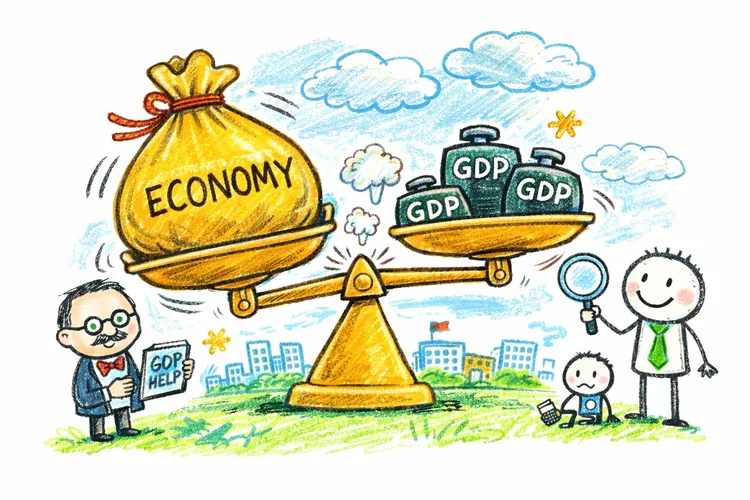
In the 1930s, during the Great Depression, the U.S. government faced a surprising problem.
No one actually knew how large the American economy was.
Factories were closing. Millions of people were unemployed. Banks were collapsing. Yet policymakers lacked a single number that described the economy as a whole.
Imagine trying to run a hospital without knowing the patient’s temperature.
That challenge led the U.S. Congress to ask economist Simon Kuznets to design a way to measure the entire economy.
The result became known as Gross Domestic Product — GDP.
Today it is the most famous number in economics.
What GDP Measures
GDP measures the total value of all final goods and services produced within a country over a specific period, usually a year or a quarter.
This includes almost everything produced in the economy:
- cars manufactured in factories
- homes constructed by builders
- software written by programmers
- restaurant meals and airline tickets
- everyday services like haircuts or repairs
If something is produced and sold in the market, it likely appears in GDP.
In simple terms, GDP functions like a scoreboard for economic activity.
The Famous Formula
Economists often explain GDP using four main sources of spending.
The entire economy can be simplified into four groups of buyers:
Consumers
People purchasing everyday goods and services.
Businesses
Companies investing in buildings, equipment, and technology.
Government
Public spending on infrastructure, education, defense, and healthcare.
The Rest of the World
Foreign demand for exports minus imports.
This leads to the well-known formula:
GDP = C + I + G + (X − M)
Where:
C = Consumption
I = Investment
G = Government spending
X − M = Net exports
Behind this simple equation lies an enormous statistical effort involving surveys, corporate reports, and national accounting systems.
Why GDP Became So Influential
GDP quickly became the standard way to track economic performance.
Politicians reference it.
Investors watch it.
Financial news reports it every quarter.
If GDP grows, the economy is expanding.
If it declines for two consecutive quarters, economists often describe the situation as a recession.
In developed economies like the United States and Canada, long-term growth rates typically average around 2–3% per year.
Even small changes in GDP growth can influence markets, interest rates, and government policies.
How GDP Connects to Daily Life
Although GDP sounds abstract, it affects everyday life.
When GDP grows:
- businesses hire more workers
- wages often rise
- tax revenues increase
- governments have more room to spend
When GDP slows or declines:
- layoffs increase
- business investment falls
- consumer confidence weakens
This is why quarterly GDP announcements often dominate economic headlines.
They are one of the fastest ways to check the economic pulse of a country.
The Famous Warning
Ironically, the economist who created GDP warned people not to rely on it too heavily.
Simon Kuznets told Congress that:
> “The welfare of a nation can scarcely be inferred from a measure of national income.”
GDP measures economic production.
But it does not measure well-being.
For example, GDP can rise when:
- hospitals treat more patients
- cities rebuild after disasters
- people spend more on medical care
But GDP does not directly measure:
- happiness
- inequality
- environmental damage
- quality of life
GDP tells us how much an economy produces, not necessarily how well people live.
Still the World’s Economic Scoreboard
Despite its limitations, GDP remains the most widely used economic indicator in the world.
Every major country calculates it.
International organizations compare it.
Financial markets react to it immediately.
If the global economy had a headline number, GDP would be it.
It is not perfect.
But it remains the closest thing economists have to a single scoreboard for economic activity.