
Fusion Energy: The Promise Beyond the Cycle
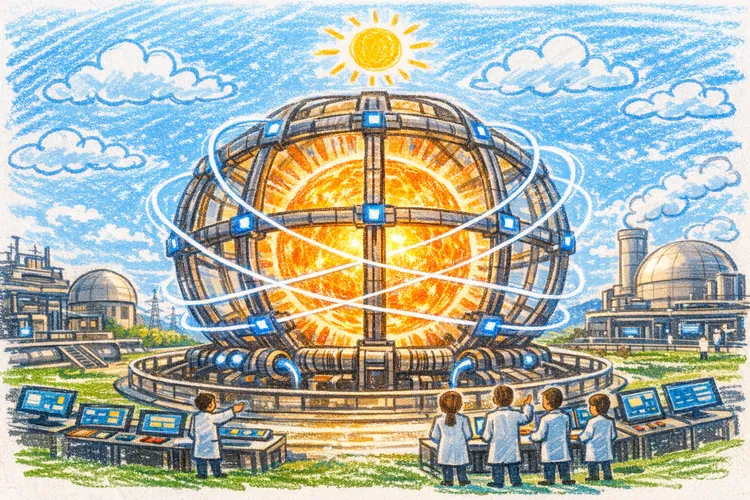
If nuclear fission is about stability, fusion is about possibility.
Fusion energy promises:
- enormous energy density
- no CO₂ emissions during generation
- far fewer long-lived radioactive byproducts
- fuel sources that appear abundant on a human timescale
Yet fusion has carried a persistent reputation for decades:
“Always 30 years away.”
So what has changed — and what hasn’t?
Three Centers of Fusion Ambition
United States: Speed and Commercialization
The U.S. fusion ecosystem combines:
- national laboratories
- private startups
- venture capital investment
Recent breakthroughs in inertial confinement experiments demonstrated net energy gain at the physics level — an important scientific milestone.
However, this is still far from a commercial power plant.
The American strategy focuses on:
- multiple competing technological approaches
- rapid experimentation
- potential commercialization paths in the 2030s or later
Europe / France: ITER as Proof of Principle
ITER, currently under construction in France, is the world’s largest fusion experiment.
Its purpose is not electricity generation.
Instead, ITER aims to prove something more fundamental:
that controlled fusion can work at industrial scale.
ITER represents:
- long timelines
- international collaboration
- engineering research rather than market speed.
China: Long-Term Engineering Momentum
China is pursuing fusion through a systematic engineering strategy:
- long-duration plasma experiments
- incremental improvements in performance
- plans for demonstration reactors in the 2030s and beyond
This approach focuses less on rapid commercialization and more on building industrial capability.
Shared Challenges
Despite their different strategies, all fusion programs face similar obstacles:
- maintaining extreme plasma conditions
- developing materials that survive neutron bombardment
- extracting heat efficiently
- managing the fusion fuel cycle.
The hardest challenge is not scientific discovery.
It is building systems that work reliably at industrial scale.
Fusion is not one breakthrough away.
It is many engineering problems solved step by step.
The Economic Reality
Fusion will not replace fossil fuels or conventional nuclear power in the near term.
But economically, it already matters because it:
- attracts long-term investment
- accelerates progress in advanced materials and superconducting magnets
- stimulates innovation in lasers, robotics, and control systems.
Fusion is therefore less a solution for the 2030s —
and more a long-term bet on the energy system after 2040–2050.
A Careful Conclusion
Fusion may not eliminate energy scarcity.
Or it may redefine it.
History suggests both optimism and caution.
Fusion is neither a miracle nor a myth.
It is a slow, expensive, and strategically significant experiment.
If it succeeds, it could transform not just electricity generation —
but the very idea of energy limits.