
Free Money? The Economics of Universal Basic Income
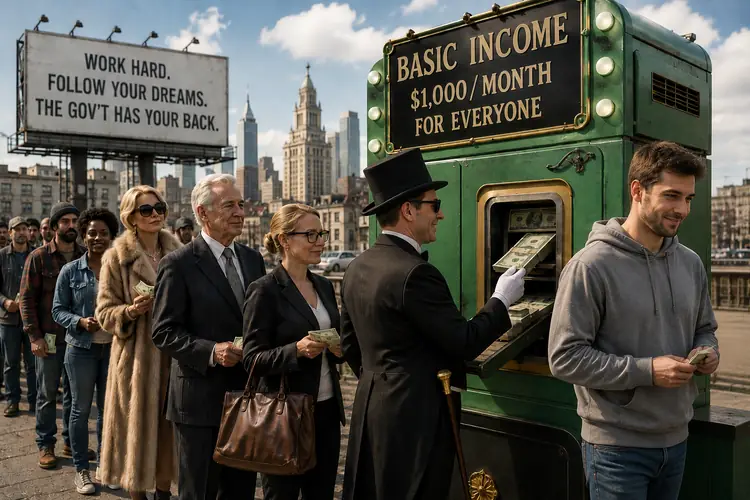
Imagine waking up on the first day of every month and finding $1,000 in your bank account.
You didn't earn it. You didn't apply for it. You don't have to prove that you're poor, unemployed, disabled, or looking for work. The government simply sends you the money. Every month. And your neighbor gets it too. So does your boss. So does the millionaire across town.
This is the basic idea behind Universal Basic Income, or UBI — one of those economic proposals that sounds either brilliantly simple or completely absurd, depending on whom you ask.
But behind the political arguments lies a much more interesting economic question:
What happens when income is no longer entirely connected to work?
The Radical Idea Is Surprisingly Simple
Most welfare programs are built around conditions.
You receive unemployment benefits because you lost your job. You receive certain subsidies because your income is low. You may qualify for assistance because you have children, a disability, or meet some other requirement.
UBI turns that logic upside down. A true universal basic income is a regular cash payment made without conditions and regardless of earnings or employment status. No forms proving that you're poor. No requirement to search for a job. No bureaucrat deciding whether you deserve the money. And, crucially, no automatic loss of the payment when you start earning more.
That last point matters. Traditional welfare systems can sometimes create strange incentives. Earn another dollar and you may lose part of your benefits. Earn enough, and several benefits may disappear at once.
UBI tries to eliminate that problem with a remarkably blunt instrument:
Just give everyone the money.
Which immediately creates another problem. Why give money to people who don't need it?
Why Send $1,000 to a Millionaire?
This may be the strangest part of UBI. If Jeff has $200 in his bank account and Jennifer has $20 million, why should both receive the same government check?
The answer is that universality is partly about simplicity.
Think about public schools. We don't ask parents to prove poverty before allowing their children into a public classroom. The service is broadly available, while the tax system determines who ultimately pays more for supporting it.
UBI could operate according to similar logic. Everyone receives the payment, but higher-income households could effectively return some or all of it through taxes.
So the important number isn't necessarily the check you receive. It's the difference between what you receive and what you pay. A wealthy household might receive $12,000 during the year but pay considerably more than that in additional taxes. A low-income household might receive the same $12,000 while paying little extra.
The payment is universal. The economic benefit doesn't have to be.
Then Comes the Trillion-Dollar Question
Suppose the United States decided to pay $1,000 per month to roughly 260 million adults. The arithmetic is brutal:
$1,000 × 12 months × 260 million people. That's about $3.1 trillion a year in gross payments.
Suddenly, free money doesn't look very free.
But that headline number can also be misleading. A real UBI system might replace some existing benefits. Taxes could recover much of the payment from higher-income households. Other tax deductions or credits might disappear.
The actual fiscal cost would therefore depend entirely on how the program was designed.
Still, there is no escaping the central problem. A meaningful UBI is expensive. Providing meaningful unconditional payments would require some combination of higher taxes, reductions in existing benefits, new government revenue, or larger deficits.
And this is where the friendly philosophical debate about freedom suddenly becomes an argument about tax rates.
But Would People Still Work?
This is probably the most emotionally charged question surrounding UBI. If people can receive money without working, won't some simply stop working? Probably some would. But that doesn't necessarily mean millions of people would abandon their jobs and spend their afternoons watching Netflix.
One of the largest recent U.S. experiments offers an interesting glimpse. OpenResearch conducted a randomized study in which 1,000 lower-income Americans received $1,000 per month for three years, while 2,000 people in a control group received $50 per month.
Recipients did work somewhat less. On average, they worked about 1.3 fewer hours per week and were roughly 2 percentage points less likely to be employed than the control group.
That is neither the collapse of the work ethic nor proof that free money has no effect on work. It is something more economically interesting. People changed their choices. Some gained the ability to wait longer for a better job. Some reduced working hours. Some had more flexibility in deciding how much income they needed versus how much time they valued.
In other words, money didn't simply buy things. It bought options.
And that may be one of the strongest arguments for UBI.
The Robot in the Room
There is another reason the idea refuses to disappear: technology.
For centuries, new machines have destroyed some jobs and created others. The tractor displaced farm labor. Factories replaced many craftsmen. Computers eliminated entire categories of clerical work while creating software engineers, digital designers, cybersecurity specialists, and industries that previously didn't exist. So far, capitalism has been remarkably good at inventing new things for humans to do.
But AI and robotics have revived an uncomfortable question:
What if machines eventually become better at replacing jobs than the economy becomes at creating them?
We don't know whether that will happen. But UBI offers one possible answer. If robots and AI produce more goods and services with less human labor, perhaps society could separate a small part of income from employment. Machines produce more. Humans receive part of the economic dividend.
It sounds elegant. Until you remember the $3 trillion.
Wouldn't Everyone Just Spend the Money?
Mostly, yes. That's the point. Money sitting in a government account doesn't buy groceries, pay rent, repair cars, or hire plumbers. Money in household accounts does.
Research from the OpenResearch experiment found that cash transfers increased measured household spending by at least $300 per month, with particularly large increases in housing, food, and automobile-related expenses.
That spending becomes somebody else's income. Your grocery bill becomes revenue for the supermarket. Your rent becomes income for the property owner. Your car repair pays the mechanic.
This creates the appealing possibility that part of UBI would circulate through the economy rather than simply disappear.
But here comes another uncomfortable question. If millions of people suddenly have more money to spend while the number of apartments, doctors, houses, and other scarce goods doesn't increase equally fast, what happens?
Prices may rise. UBI can increase purchasing power. It cannot magically create more housing.
That's an important distinction.
Maybe the Real Product Isn't Money
The debate over universal basic income is usually presented as a fight between generosity and responsibility.
Supporters say people deserve economic security.
Critics say people should work for their money.
But economics gives us a more interesting way to look at it. UBI is really about risk. Today, losing your job can mean losing nearly all your labor income at once. That makes people cautious. A guaranteed income floor could change that calculation.
Leaving a terrible job becomes easier. Going back to school becomes less dangerous. Starting a small business becomes slightly less terrifying. Taking care of a child or an aging parent becomes economically possible for more people.
The most valuable thing UBI might provide isn't $1,000. It might be the ability to say no. No to a bad job. No to an impossible schedule. No to staying somewhere simply because missing one paycheck would be catastrophic.
And that would change the balance of power in the labor market. Employers might have to pay more for unpleasant work. Some wages could rise. Some jobs might become automated faster. Some businesses might disappear.
UBI wouldn't merely redistribute money. It could change the price of human time.
Free Money Doesn't Exist
This is where the fantasy ends. There is no giant government vault containing trillions of unused dollars waiting to be distributed. Someone ultimately pays. Workers. Consumers. Investors. Businesses. Future taxpayers. Or some combination of them.
The serious UBI debate is therefore not really about whether everyone should receive a check. The question is whether we are willing to redesign the relationship between work, taxes, income, and economic security.
For most of modern economic history, the deal has been straightforward:
You work. You earn. You consume.
Universal basic income proposes a subtle but radical change:
You exist. Therefore, you receive a minimum economic floor.
Work still matters. Markets still matter. Wages still matter. But survival would no longer depend entirely on selling your labor.
That is why UBI is simultaneously attractive, frightening, expensive, and difficult to dismiss.
The real question isn't whether free money sounds nice.
It's what kind of economy we create once some income no longer begins with a job.