
Can North America Break Free? The Hard Truth About Rare Earth Independence
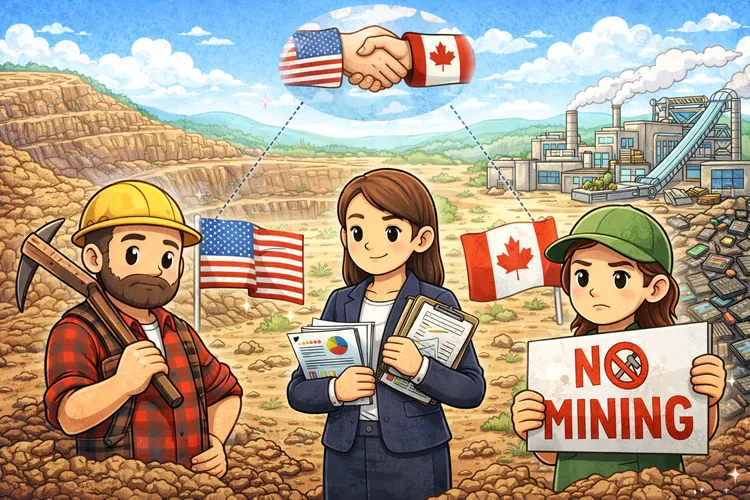
If rare earth metals are strategic…
and supply chains are concentrated…
then the key question is simple:
Can North America become independent?
The illusion of “just mine more”
The U.S. and Canada have resources:
- Mountain Pass (USA),
- deposits across Canada.
The issue is not mining.
It’s processing.
Ore must go through:
- chemical separation,
- refining,
- manufacturing.
That’s where the bottleneck lies.
Recycling: promising, but limited
Recycling sources:
- electronics,
- EV motors,
- wind turbines.
Challenges:
- small quantities per device,
- complex extraction,
- fragmented systems.
Recycling helps —
but won’t replace primary supply.
Environmental trade-offs
Processing involves:
- chemicals,
- waste,
- strict controls.
Societies want:
clean energy
but resist:
local industrial activity.
This paradox slows development.
The cost of security
Building supply chains requires:
- subsidies,
- partnerships,
- long-term planning,
- government support.
This is industrial policy — not pure market logic.
Independence vs diversification
Full independence is unlikely.
More realistic:
- diversify supply,
- build partial capacity,
- partner with allies,
- innovate.
Resilience > isolation.
A broader shift
The global economy is changing:
From:
- efficiency
- low cost
To:
- resilience
- security
This transition is costly —
but dependence is riskier.
Final thought
Rare earths are not just materials.
They are strategy.
And the era of ignoring them is over.