
A Coin Puzzle from a Tiny Country
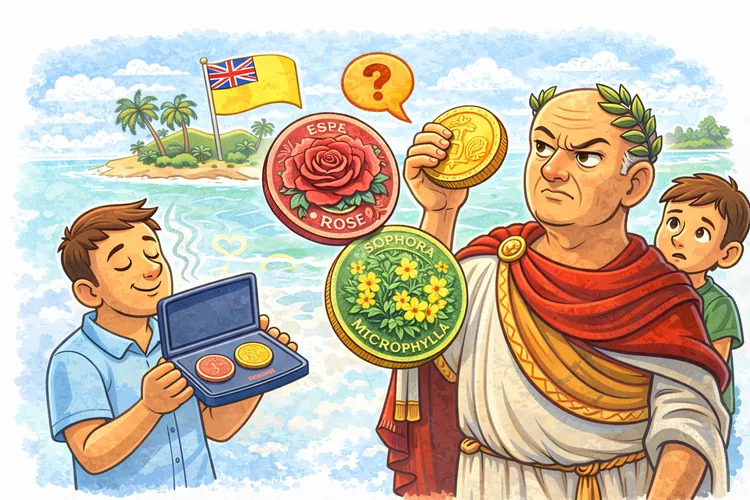
Here’s a small puzzle from the world of unusual money.
The Polynesian country Niue once issued a collectible series of two coins.
The coins were called:
- Rose
- Sophora Microphylla
Both coins had unusual colors and a special feature.
Because of that feature, they unintentionally disproved a very famous saying about money — a phrase that has been repeated for almost two thousand years.
The question is simple:
What famous expression do these coins contradict —
and what special property did the coins have?
Take a moment to think about it.
It’s not a trick question, but the answer becomes obvious once you know the story behind the phrase.
The Answer
The coins quietly contradict a phrase attributed to the Roman emperor Vespasian:
“Money doesn’t smell.”
According to Roman historians, Vespasian introduced a tax on public urinals in Rome. His son Titus reportedly complained that it was a shameful source of revenue. In response, the emperor held up a coin from the tax and asked whether it smelled. When Titus said no, Vespasian replied that money has no smell — meaning that once money enters the treasury, its origin doesn’t matter.
Except these coins… did.
They were scented coins, infused with the fragrances of the flowers printed on them — rose and sophora.
When collectors opened the packaging, the coins actually smelled like the flowers they depicted.
For perhaps the first time in history, money literally had a scent.
When Famous Sayings Meet Reality
Of course, the ancient phrase was never meant to be taken literally.
It was about the idea that money itself is neutral, regardless of where it comes from.
But this little story reminds us of something interesting.
Even the most famous pieces of wisdom can meet unexpected exceptions.
Sometimes those exceptions appear because of new technology.
Sometimes because of creative design.
And sometimes simply because someone decided to make a coin that smells like flowers.
A proverb can survive for centuries — and still be quietly disproved by a mint in a small Pacific island nation.
It’s a good reminder that even our most confident statements about the world should probably come with a small footnote:
“Usually true… but not always.”