
Who Is Winning the New Space Race?
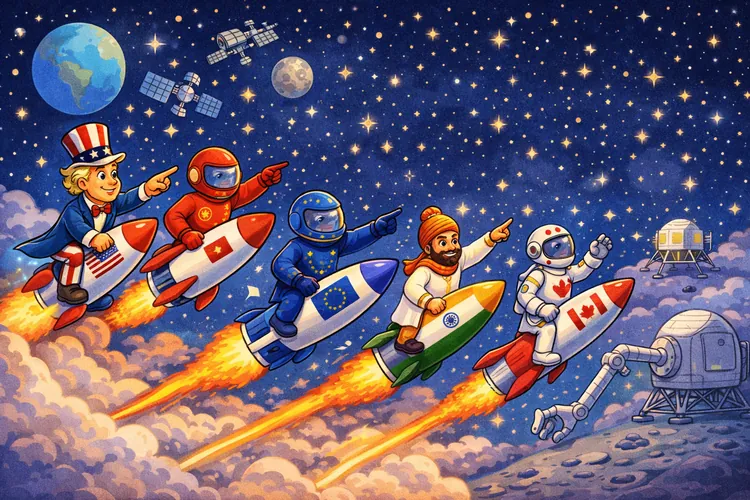
For decades, the Space Race was simple.
Two superpowers. One goal. First to the Moon wins.
Today, the race is far more crowded — and far more complicated.
There is no single finish line. No single prize.
Instead, there are multiple races happening at once:
- Who dominates satellite infrastructure
- Who controls launch capabilities
- Who builds lunar presence
- Who defines the rules of space commerce
And unlike the 1960s, this race is not just about flags.
It’s about markets, technology, and long-term economic power.
The United States: The Hybrid Model
The United States remains the most advanced space economy in the world — but not for the reasons you might expect.
Yes, NASA is still a major player. But the real strength of the U.S. model is something new:
a partnership between government and private companies.
NASA increasingly acts as a customer, not just a builder.
Instead of designing every rocket in-house, it funds and contracts companies like:
- SpaceX
- Blue Origin
- Northrop Grumman
This creates a powerful feedback loop:
- Government funding reduces risk
- Private competition drives innovation
- Costs go down
- New markets emerge
The result? The U.S. is not just exploring space — it is building an ecosystem.
And ecosystems tend to win.
Back to the Moon: A New Kind of Lunar Mission
One of the most visible demonstrations of the U.S. space model came with NASA’s recent return to lunar exploration through the Artemis program.
For the first time in more than fifty years, the United States is preparing to send astronauts back toward the Moon. But unlike the Apollo era, this is not simply a race to plant a flag.
The Artemis missions represent something much larger: an attempt to build a permanent economic and technological presence beyond Earth.
The recent crewed flight around the Moon attracted global attention because it showed that human deep-space exploration is no longer a historical achievement remembered from the 1960s. It is becoming an active strategic objective once again.
What makes Artemis particularly interesting from an economic perspective is how it reflects the hybrid American model described earlier.
NASA remains the organizer and long-term planner, but many of the key technologies are supplied by private companies. SpaceX is developing the lunar landing system, while numerous contractors provide components, infrastructure, and support services.
In other words, the Moon is increasingly being approached not as a one-time destination, but as the foundation of a future market.
Supporters see this as the beginning of a new era of exploration and innovation. Critics point to rising costs, technical delays, and the uncertainty of whether lunar activities will ever become economically self-sustaining.
Yet regardless of the outcome, the mission sends an important signal to the rest of the world: the United States is not merely participating in the new Space Race. It intends to remain one of the countries setting its direction.
And in a competition where long-term ambitions matter as much as current achievements, that signal may be almost as important as the flight itself.
China: The State-Driven Challenger
If the United States represents a hybrid model, China represents the opposite.
China’s space program is highly centralized and state-controlled.
There is no true equivalent of SpaceX operating independently.
Instead, major projects are coordinated through government-led organizations.
At first glance, this may seem less efficient. But it has a key advantage:
focus.
China does not need to justify projects to investors or quarterly earnings. It can plan decades ahead. And it shows.
China has:
- Built its own space station
- Successfully landed rovers on the Moon and Mars
- Developed a full launch capability independent of Western systems
Its long-term goal is clear:
become a dominant space power by the 2030s.
Not just scientifically — but economically.
Europe: The Careful Collaborator
Europe takes a very different approach.
Through the European Space Agency (ESA), multiple countries pool resources and share costs.
This creates stability — but also complexity. Decisions take longer. Budgets are negotiated across nations. As a result, Europe is:
- strong in satellite technology
- competitive in scientific missions
- but less aggressive in commercial launch innovation
In economic terms, Europe is playing a defensive game.
It wants to remain relevant — not necessarily dominate.
India: The Efficiency Specialist
India’s space program is one of the most fascinating in the world.
It operates on a fraction of the budgets of the U.S. or China — yet delivers impressive results.
The Indian Space Research Organisation (ISRO) has become known for:
- low-cost missions
- efficient engineering
- rapid development cycles
India’s strategy is not to outspend competitors. It is to out-optimize them.
This makes India particularly competitive in:
- small satellite launches
- cost-sensitive missions
- emerging markets
In economic terms, India is positioning itself as the “budget provider” of space services.
And in many industries, that’s a very powerful position.
Japan and Canada: Precision Over Scale
Not every country is trying to dominate space. Some are choosing specialization.
Japan focuses on:
- robotics
- precision engineering
- deep-space missions
Canada is famous for:
- robotic arms (like the Canadarm)
- satellite technology
- niche high-value components
These countries are not competing for size. They are competing for importance.
In modern supply chains, being indispensable can be just as valuable as being dominant.
The Real Scoreboard
So who is winning?
It depends on how you define “winning.”
- If it’s innovation and commercialization → United States
- If it’s long-term strategic control → China
- If it’s cost efficiency → India
- If it’s precision technology → Japan and Canada
There is no single leader.
There is a global system forming.
And that may be the most important shift of all.
The Hidden Competition: Rules and Power
There is one more layer to this race — and it may matter the most.
Who writes the rules?
Space law is still evolving:
- Who owns resources mined from asteroids?
- Who controls lunar infrastructure?
- How are orbits regulated?
The countries and companies that answer these questions will shape the economy of space for decades.
In other words: the real race is not just about rockets.
It’s about who defines the market itself.
A Race Without a Finish Line
The original Space Race ended with a moment:
a human stepping onto the Moon.
This race will not end that way. There will be no single victory.
Instead, there will be a gradual shift — from exploration to industry.
From government dominance to mixed economies.
From prestige to profit.
And when that shift is complete, we may realize something surprising:
The winners of the new Space Race won’t just be the ones who reached space first.
They’ll be the ones who figured out how to make space pay.