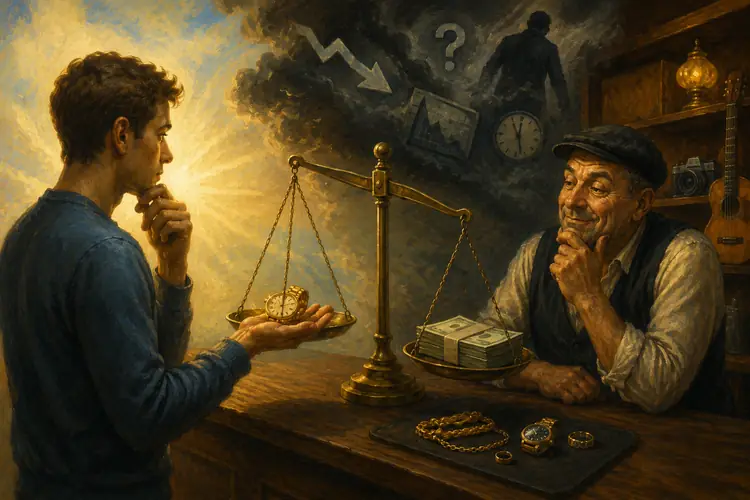
Most people think pawn shops make money by lending cash. They don't.
What they really sell is certainty. And what they really buy is risk.
Understanding that single idea explains almost everything that seems confusing—or unfair—about how pawn shops work.
Why Doesn't the Pawn Shop Pay Full Value?
Imagine you own a gold watch worth $1,000. You walk into a pawn shop expecting to borrow close to that amount. Instead, you're offered perhaps $500 or $600.
Many people immediately think: "They're trying to cheat me." But that's usually not what's happening. The pawn shop isn't buying your watch. It's buying uncertainty. It doesn't know whether you'll return. It doesn't know whether the market price of gold will fall. It doesn't know whether another buyer will want that exact model. It doesn't know how long the watch might sit in a display case before selling.
Every one of those unknowns has a price.
The lower loan amount is the cushion that protects the business against those risks.
The Business Doesn't Want Your Watch
Here's one of the biggest misconceptions about pawn shops. People often imagine the owner hopes customers never repay their loans.
In reality, the opposite is usually true.
The ideal transaction is surprisingly simple. A customer receives a loan. Pays the interest. Returns. Repays the loan. Takes the item home.
The pawn shop earns predictable income without ever needing to sell anything.
Selling collateral creates work. Employees must test the item. Clean it. Photograph it. Display it. Store it securely. Advertise it. Negotiate with buyers. Sometimes the item sits unsold for months.
That is far less efficient than earning interest on a short-term loan.
Why Are Interest Rates Higher?
Pawn loans often carry higher interest rates than traditional bank loans.
At first glance, that seems unfair. Until you compare the two businesses.
Banks invest enormous resources into evaluating borrowers. They check employment. Income. Credit history. Existing debts. Repayment behavior. That screening allows them to lend at relatively low interest rates because they reject many risky applicants before making a loan.
Pawn shops do almost none of that. Almost anyone with a valuable item can qualify. The business accepts far more uncertainty. Higher risk usually requires higher returns. That principle appears throughout economics. Insurance works the same way. Investing works the same way. Even airlines charge more for refundable tickets because they carry more uncertainty.
Pawn shops are no different.
Collateral Changes Everything
Banks primarily trust people. Pawn shops primarily trust objects.
That difference creates a completely different economic model.
If a borrower cannot repay a bank loan, collecting the money can become expensive and time-consuming. Lawyers. Collection agencies. Court proceedings. Credit reporting.
A pawn shop rarely faces those costs. The collateral already exists. If the customer never returns, ownership simply transfers according to the loan agreement. That dramatically reduces one kind of financial risk.
But it introduces another: the risk that the collateral sells for less than expected.
That is why pawn shops are often conservative when estimating value.
Why Some Items Receive Better Offers
Not all valuable possessions make good collateral.
Suppose someone offers two items worth roughly the same amount. One is a popular gold necklace. The other is a custom-made sculpture. Both may be worth $2,000.
Yet the necklace will probably receive a much larger loan.
Why? Because it is easier to sell. Economists call this
liquidity.
Liquidity measures how quickly an asset can be converted into cash without losing much of its value. Gold is highly liquid. Designer watches often are. Recent smartphones usually are. A unique sculpture may not be. Its value depends on finding exactly the right buyer.
The easier something is to sell, the more valuable it becomes as collateral.
Time Is Also a Cost
Imagine two identical laptops. One sells tomorrow. The other sells six months from now.
Even if both eventually sell for exactly the same price, the first laptop is economically more valuable. Why? Because money tied up in inventory cannot be used elsewhere.
Businesses call this the
cost of capital. Every day an unsold item remains on the shelf, it occupies storage space and locks away money that could have financed another loan.
Pawn shops therefore care about more than value. They also care about speed.
An item that sells quickly is often worth more to the business than a technically more expensive item that hardly anyone wants.
The Customer Is Paying for Options
Many people compare pawn loans with selling an item outright. But they are not the same transaction.
When you sell something, ownership ends immediately. When you pawn it, you purchase an opportunity. You buy time. Perhaps next month your paycheck arrives. Perhaps your business receives payment from a client. Perhaps an unexpected expense disappears.
The loan gives you the option of recovering something valuable later.
In finance, options often have value. Pawn lending quietly demonstrates this principle in everyday life.
Why Pawn Shops Survive Competition
Modern financial technology has transformed lending.
Apps can approve personal loans in minutes. Digital wallets move money instantly. Credit cards are available almost everywhere.
Yet pawn shops continue operating. Why? Because they solve a problem that many digital lenders cannot. They lend against possessions rather than personal financial history.
For some customers, that difference matters more than interest rates. For others, it offers privacy. For still others, it offers speed.
Different financial institutions compete by solving different problems. Pawn shops have survived because they continue solving one that never entirely disappears.
Looking Beyond the Price Tag
It is easy to judge a pawn loan by comparing the amount borrowed with the market value of the item. But that comparison misses much of the economics involved.
The loan reflects uncertainty. Future resale value. Storage costs. Insurance. Security. Market demand. Time. Risk. And the possibility that the customer may never return.
What appears to be a simple transaction is actually a carefully balanced calculation involving dozens of economic factors.
The Quiet Lesson
Pawn shops do not price objects. They price uncertainty. The watch, the necklace, the guitar, or the laptop simply gives them a way to measure it.
Seen from that perspective, the business begins to make much more sense. It is not a store that hopes to acquire your possessions. Nor is it merely a lender charging interest. It is a marketplace where risk itself has a price.
And like every market, that price reflects something far more complicated than most of us notice at first glance.